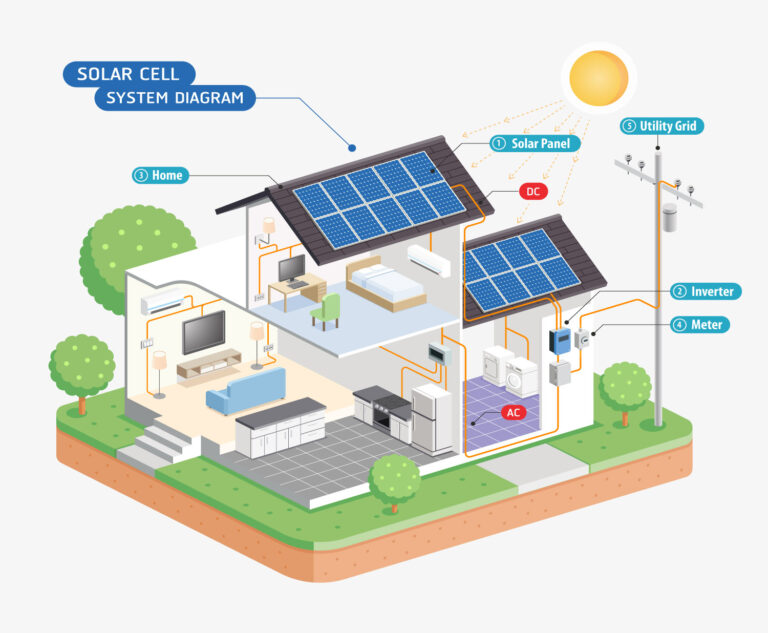
Solar photovoltaic (PV) technology, initially developed in the 1960s for space exploration, has evolved into a reliable and efficient solution for commercial and industrial energy needs. Today, this mature technology is widely deployed on rooftops to generate electricity for a variety of applications. Here’s how the process works:
Installation and Orientation: Solar PV modules are strategically installed on building rooftops to maximize exposure to sunlight throughout the day.
Conversion of Solar Energy: When sunlight hits the PV modules, it is converted into Direct Current (DC) electricity.
Inversion to Usable Power: The DC electricity flows through cables to an inverter, a device that converts it into Alternating Current (AC) electricity. This AC electricity is compatible with most electrical equipment, including machines, computers, lighting systems, and air conditioning units.
4. Utilization and Export: The AC electricity generated is used to power the facility. Surplus electricity, if any, can be exported back to the grid, allowing facility owners to contribute to the local energy supply.
5. Monitoring and Tracking: All generated electricity is meticulously tracked, and facility owners have easy access to real-time data, ensuring complete transparency and control.